.png)
.png)
About the work
Curatorial Introduction for Martine Jacobs’ Foundational 1998 Collection by Cansu Waldron
Martine Jacobs’ digital practice emerges from a moment before the language, market, or institutional frameworks for “digital art” existed.
Her archive of more than 350 works created between 1998 and 2007 is one of the most emotional and overlooked bodies of early internet art — a record of how people were feeling online as the digital world was taking shape.
What so relevant today is that it does not follow the dominant digital art narrative of its time.
Instead, it presents a deeply personal feminist intervention into the early web. While much early net art focused on code, conceptualism, or software aesthetics, Jacobs turned toward protest, spirituality, desire, grief, and the intimate emotional lives of women.
She was building a visual language for feeling at a moment when the internet had not yet learned how to hold emotion, insisting that vulnerability was not a weakness in the digital realm, but a form of authorship.
This positioning places Jacobs within a parallel lineage of feminist digital practice that has yet to be fully historicized.
Long before the language of digital identity, collective storytelling, or Web3 community emerged, she was already using the internet as an emotional commons — a space where shared vulnerability became a source of connection and quiet power.
For this reason, her archive is not only relevant to institutions such as The Feminist Institute, but essential to understanding the roots of contemporary female-focused digital communities, including World of Women.
Jacobs’ entry into digital art began in 1998, when access to a Pentium II computer and early versions of Adobe and Paint Shop Pro offered what she describes as “complete liberation.” Classically trained in charcoal and pastel, she immediately recognized the potential of digital manipulation — its capacity to layer, distort, and reimagine images with unprecedented speed.
While peers dismissed the computer as cold or inauthentic, Jacobs approached it as a site of intimacy, infusing digital images with the warmth of her analog sensibility.
This blend of emotional vulnerability and resilience defines Jacobs’ archive, where intimacy, grief, and spiritual searching converge into a radical assertion of feminine agency.
Her work treats the early internet as a space for shared emotion, where sorrow, empathy, and reflection could exist openly and collectively.
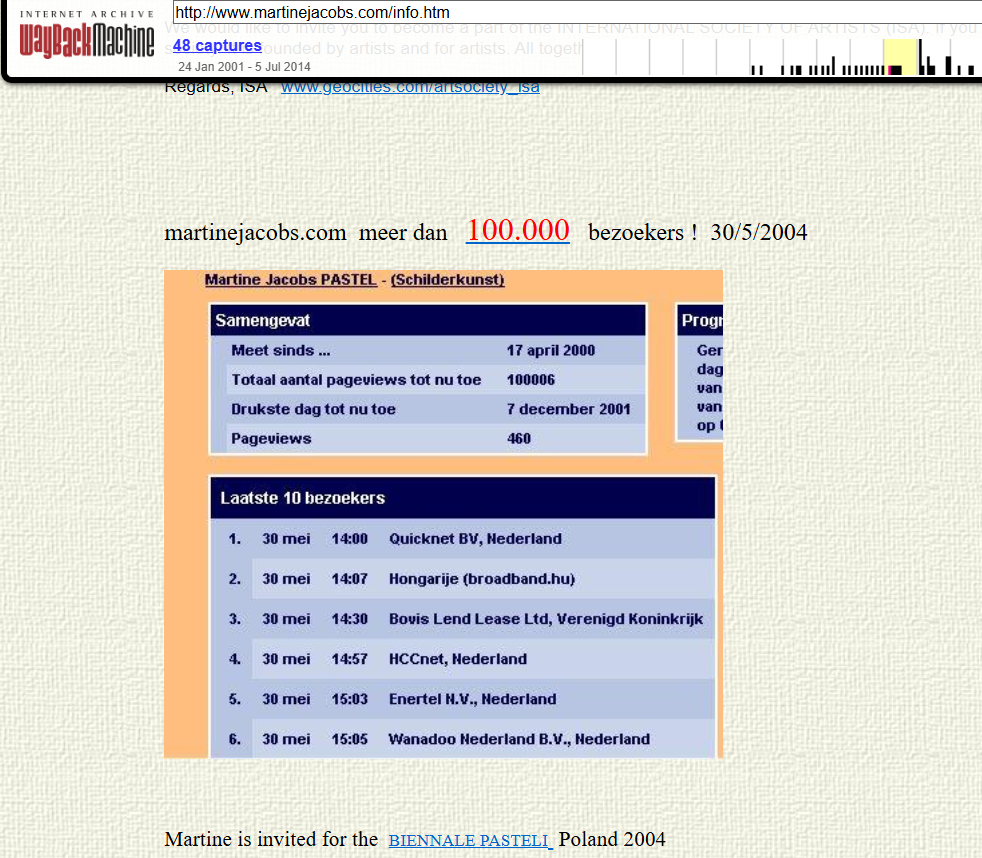
At a time when traditional media struggled to convey largescale grief, her digital portals drew over 100,000 visitors, creating an early, horizontal emotional commons.
Across the archive, Jacobs shows that vulnerability is not weakness but a form of authorship, and that feminine strength need not be restrained by fear, societal expectation, or technological limits.
Her practice anticipates contemporary movements reclaiming myth, identity, and power, demonstrating that the emotional, political, and spiritual stakes of digital art are inseparable from its medium.
All of these works gain new meaning now that the archive has been formally preserved by the Internet Archive.
After years of risking disappearance through obsolete interfaces, expired software, and browser constraints, this recognition marks a turning point — establishing Jacobs’ practice not only as digital art, but as a historical record of digital emotion.
This is the significance of Martine Jacobs’ archive: it reveals the emotional, feminist, and political roots that continue to shape digital art today. It shows that one of the most important stories of the early web was happening outside the mainstream narrative, created by a woman using digital tools to map the inner landscapes of a world in transition.
The Woman Will Cry Blood (1998)
Digital composition / Emotional surrealism / Anti-war protest
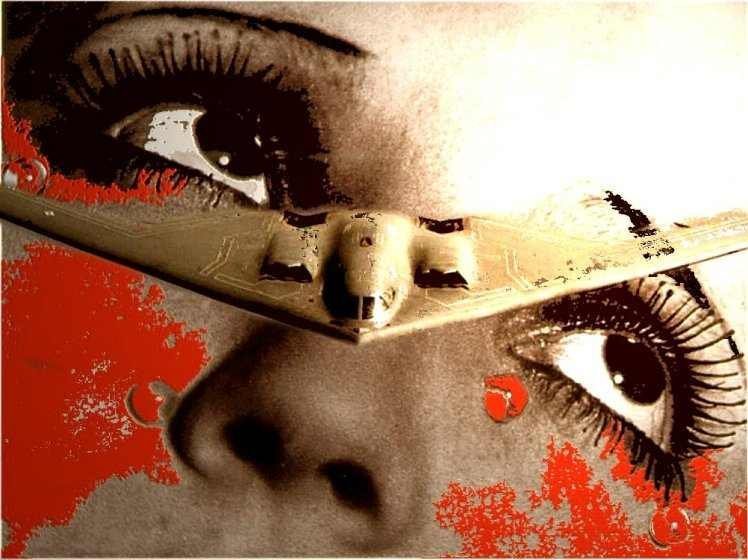
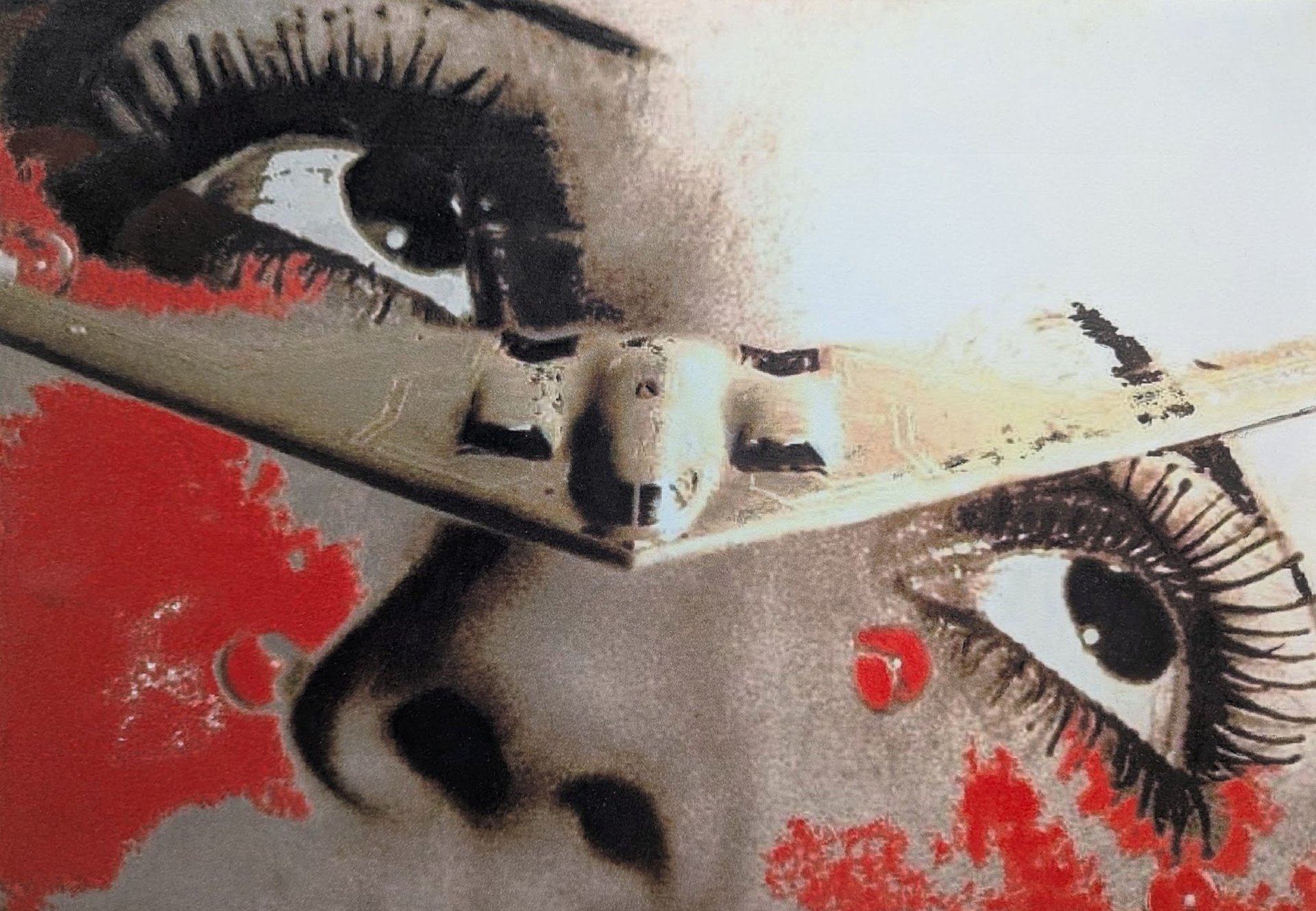
The Woman Will Cry Blood is a digitally composed protest artwork created in 1998 using Paint Shop Pro on a Pentium II system. A close-up of a woman’s face dominates the composition — her eyes wide, lashes exaggerated, skin stylized in red and orange tones. A military aircraft slices horizontally across her face, resembling a stealth bomber, its presence both literal and symbolic. The surreal juxtaposition evokes themes of surveillance, violence, and emotional rupture.
This piece is a direct protest against war and militarized spectacle. The woman’s gaze is frozen, yet the implied tears — blood — signal trauma, violation, and psychic invasion. The aircraft becomes a metaphor for intrusion, domination, and the erasure of emotional interiority. Created in the pre-platform era, this work stands as an early digital relic of feminist resistance, emotional testimony, and symbolic confrontation. It belongs to Martine Jacobs’ Emotional Surrealworks and Protest Icons constellations, where the body becomes a site of political and spiritual rupture.
confrontation
Cansu Waldron: “These anonymous gatherings allowed sorrow to be shared without hierarchy or spectacle, anticipating the emotional infrastructures of the internet we now take for granted. This impulse finds its most direct expression in The Woman Will Cry Blood. Created in response to an Iraqi minister’s statement during the Gulf War, the work overlays a woman’s eyes with a warplane, collapsing private emotion and geopolitical violence into a single, uncompromising image. After 9/11, it took on an unintended prophetic resonance. Its power lies in its refusal to distance suffering — vulnerability here confronts authority rather than yielding to it."
Specifications
| Publisher | Martine Jacobs |
|---|---|
| Framed | Not included |
| Certificate of authenticity | Included |
| Condition/details | Excellent |
| Signature | Included |


